
Heartburn, reflux and hiatal hernia after weight loss surgery
Heartburn and reflux are among the most common reasons patients come back after bariatric surgery — whichever operation they had. What matters is that the symptoms are often caused by something other than acid alone.
That distinction changes the treatment entirely. Reaching for a stronger antacid when the real problem is an obstruction, a herniated pouch or bile reflux will not help, and the underlying problem usually keeps getting worse.
Symptoms worth acting on
Most people adapt to these gradually and stop noticing them. If any of the following describes you, it's worth being seen — these symptoms usually get worse rather than better on their own.
Heartburn or reflux getting progressively worse, with medication no longer controlling it.
Difficulty swallowing that makes you choke or vomit when you eat, lie down or try to sleep.
Chest pain after eating, or food getting stuck repeatedly.
A diet that has quietly narrowed — living mostly on liquids and soft foods because solid, dry or dense foods no longer go down.
Why it might not be acid
Symptoms that feel exactly like heartburn can come from several different problems after weight loss surgery. Each one is treated differently, which is why guessing is expensive.
-
Acid reflux
Ordinary acid reflux, which may respond to a change in medication.
-
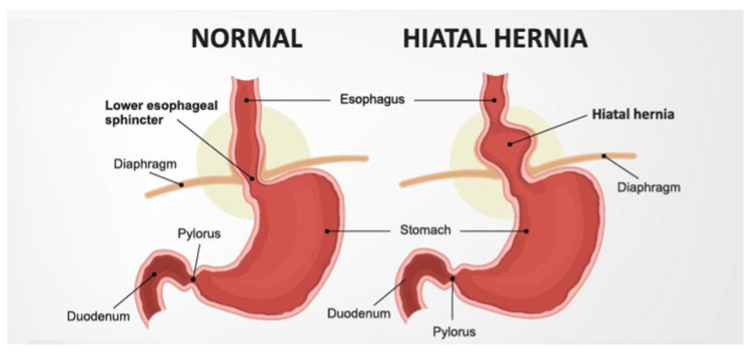
Herniation into the chest
The sleeve or bypass pouch has moved up into the chest in a way that now partially obstructs the passage of food.
-
Bile reflux
Bile refluxing up into the stomach and esophagus. It feels like acid heartburn but is a different problem, and antacids don't touch it.
-
Stricture or obstruction
A narrowing that stops food passing normally.
-
Torsion
Twisting of the sleeve, causing obstructive symptoms.
How we diagnose it
Two studies, done by a bariatric surgeon who performs revision work, will usually show what has changed since your original operation.
Upper GI swallowing study
A live X-ray of you swallowing, showing how your weight loss operation is functioning and whether anything is narrowed, twisted or displaced into the chest.
Upper endoscopy
A camera passed into the stomach to look directly at the anatomy and the esophagus — and to find inflammation, ulceration and bile that an X-ray cannot show.
The conversation
After both studies it's usually clear what's causing the problem. Your surgeon will then go through what can and cannot be corrected, and what each option would mean for you.
Your options
Which of these applies depends entirely on what the studies show. Several are managed medically or endoscopically — not every problem needs another operation.
- Changing your medication regimen
- Starting a new medication
- Stretching a stricture
- Revision of an anastomosis
- Reducing pouch size or anastomosis size
- Hiatal hernia reduction, with repair of a stomach trapped in the chest
- Converting your weight loss operation to a different one
- Reversing the weight loss operation
Let's find out what's actually causing it
Make an appointment to talk through your symptoms and arrange the studies. Only once we know what's changed can we tell you how to fix it.
Looking for a specific operation? See all revision options.