
Lap-Band revisions
If your Lap-Band has stopped working the way it should — or has started causing problems of its own — it can be adjusted, removed, or converted to another operation. The first step is finding out what has actually changed.
These symptoms usually get worse rather than better on their own. Waiting rarely helps, and the longer an obstruction or an eroding band goes unaddressed, the fewer options remain.
Symptoms worth acting on
Patients often adapt to these gradually, over months or years, until the adaptation is invisible to them. If you're doing any of the following, it's worth being seen.
Difficulty swallowing that makes you cough, choke or vomit when you eat, lie down or try to sleep.
Food getting stuck, repeatedly, rather than as a one-off.
A diet that has quietly narrowed — living mostly on liquids, sauces and light crunchy foods, and avoiding anything solid, dry, dense or doughy.
Worsening heartburn or reflux that no longer responds to medication.
What might be happening
Those symptoms point to one of a handful of Lap-Band complications. Which one it is determines what can be done about it.
-
Lap-Band intolerance
You can no longer eat solid food, whatever the band setting.
-
Esophageal dilatation
The swallowing pipe above the band has stretched.
-
Obstruction of the band
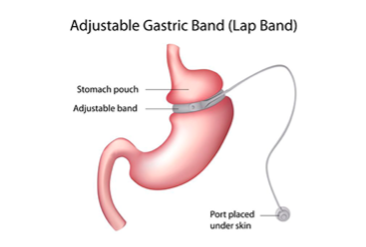
The band is too tight, sitting too high, or has slipped so that too much stomach sits above it.
-
Band slippage
The pouch above the band has enlarged and intermittently obstructs.
-
Band erosion
The band has begun to rub into the wall of the stomach.
How we diagnose it
Two studies, done by a bariatric surgeon who performs revision work, will usually tell us what has changed since your original operation.
Upper GI swallowing study
A live X-ray of you swallowing, which shows how the band is functioning and whether anything is obstructing or slipping.
Upper endoscopy
A camera passed into the stomach to look directly at the band, the stomach wall and the esophagus — and to find erosion, which an X-ray can miss.
The conversation
After both studies it's usually clear what's causing the problem. Your surgeon will then go through what can and can't be corrected, and what each option would mean for you.
Your options
Which of these applies depends entirely on what the studies show. Some are simple adjustments; others are full conversions to a different operation.
- Inflating or deflating the band
- Removing the band
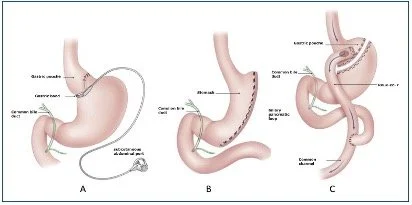
- Converting the band to a sleeve gastrectomy
- Converting the band to a gastric bypass
- Hiatal hernia reduction and repair, with or without an anti-reflux procedure
The Lap-Band is used for weight loss in people who haven't succeeded through diet and exercise alone. Many patients see less weight loss than they hoped for despite the surgery, and some develop complications. In either case, revision surgery can restore the weight loss or correct the problem.
Let's find out what happened
Make an appointment to talk through your symptoms and arrange the studies. Only once we know what's changed can we tell you how to fix it.
Had a different operation? See all revision options.